Last Updated: October 30, 2026
Quick Summary
Look for an editorial fashion photographer who can explain the story they want to tell and show complete sequences rather than single hero shots. Check that their visual approach stays consistent across shoots, that their technical quality holds up at full resolution, and that their usage rights and deliverables are agreed in writing before you book.
- Ask to see full editorials or lookbooks, not just a highlight reel.
- Check whether the lighting, color, and framing stay coherent from frame to frame.
- Score each portfolio on narrative, consistency, range, technical quality, direction, and credits.
- Get licensing terms for print, web, and social use in writing before any deposit.
- Clarify who pays for styling, hair and makeup, location, and post-production.
Table of Contents
- What Makes Fashion Photography Editorial
- Editorial vs Commercial Fashion Photography: Choosing the Right Fit
- How to Evaluate a Fashion Editorial Photographer Portfolio
- Questions to Ask Before Hiring a Fashion Photographer
- Planning the Shoot: Concept, Brief, and Budget
- Working With a Stylist and Creative Team
- Settling Usage Rights and Deliverables Before You Book
- Booking Your Editorial Shoot With KRISTIE Montrois
- Frequently Asked Questions
What Makes Fashion Photography Editorial
An editorial fashion photographer tells a story through a sequence of images, usually for a magazine, lookbook, or campaign. The clothing is the subject, but the mood, setting, and direction carry the narrative.
This is the first thing to look for: a photographer who can explain the story they want to tell and how the images will support it.
Editorial vs Commercial Fashion Photography: Choosing the Right Fit
Commercial fashion photography focuses on clear, product-forward images, often for e-commerce or catalogs, where the garment must be easy to see and compare. Editorial work leans toward atmosphere, movement, and visual narrative.
Many brands need both. Before you choose a photographer, decide which goal matters more for each project. A photographer who excels at one may not be the best fit for the other, so ask directly how they approach each type of work.
How to Evaluate a Fashion Editorial Photographer Portfolio
A portfolio is one of the most useful ways to see what a photographer has produced, so treat it as a central part of your decision rather than a formality. The goal is not to find the prettiest single image. It is to judge whether the photographer can carry a concept across a full set of frames and deliver images that hold up in print, on a product page, and in a social feed.
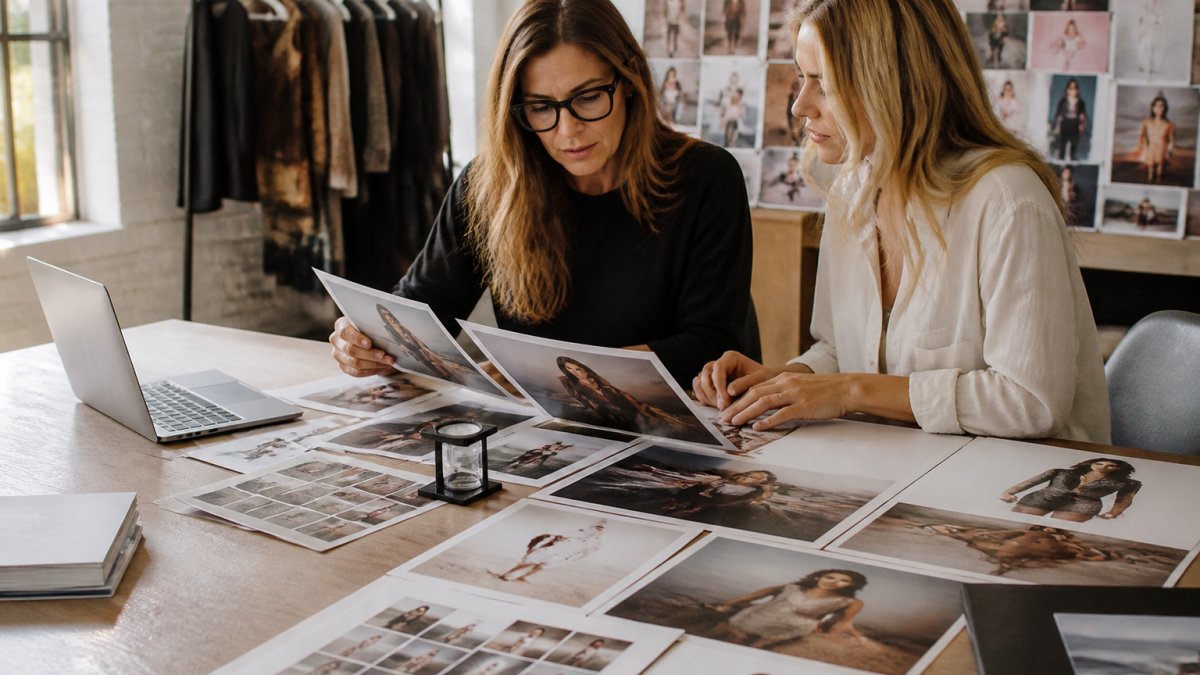
Review Full Sequences, Not Just Hero Shots
Ask to see complete editorials or lookbooks rather than a highlight reel. A full sequence shows how the photographer paces a story: the opening frame, the mid-story movement, the detail shots, and the closing image.
A useful test: cover the caption and ask whether you could describe the mood and the intended audience from the images alone. If the answer is vague, the narrative is thin.
Check Consistency Across the Set
Consistency is the difference between a photographer with a point of view and one who is assembling borrowed styles. Scan a single shoot and note whether the lighting direction, color temperature, and framing stay coherent from frame to frame. Then compare two different shoots. A strong portfolio shows a recognizable approach, a way of using light, negative space, or movement, without every project looking identical.
Open three shoots side by side on your screen. If you can tell they were made by the same person without reading the credit, the visual point of view is real. If they look like three different portfolios, ask the photographer to walk you through the choices.
Assess Range Without Losing Coherence
Range matters because editorial work spans studio sets, location shoots, and campaign imagery. Look for evidence the photographer can handle controlled studio light, natural light on location, and mixed or difficult conditions. Range should not mean randomness. The strongest portfolios show variety in subject and setting while keeping a consistent standard of craft.
Judge Technical Quality at Full Resolution
Ask to see a few images at full resolution or in print. Check focus on the eyes and garment details, highlight and shadow detail, and whether retouching looks natural rather than plastic. Editorial images often run large in print, so flaws that disappear on a phone screen become obvious on a spread. Ask what the final delivery format is and whether files are sized for print or web.
Read the Credits and Context
Published work usually carries credits for the photographer, stylist, hair and makeup, and model. Clear credits are a sign of professional practice. Ask for context on each project: Was it commissioned, self-produced, or a test? Who was the client or publication? A self-produced editorial can be excellent, but you should know what you are looking at so you can weigh it correctly.
Use a Simple Portfolio Scorecard
Score each photographer from 1 to 5 on the criteria that matter most to your project, then compare totals:
- Narrative coherence, Does a full sequence tell a story?
- Visual consistency, Is there a recognizable point of view across shoots?
- Range, Can they handle studio, location, and campaign work?
- Technical quality, Do images hold up at full resolution and in print?
- Direction of models, Do subjects look natural, engaged, and well-directed?
- Credits and context, Is the work clearly attributed and explained?
A high score in one category does not offset a low score in another. If narrative coherence and technical quality are strong but range is narrow, the photographer may still be the right fit for a focused project.
Red Flags to Watch For
- Portfolios made up only of heavily retouched or heavily staged images with no context.
- Unclear or missing credits, or images that cannot be traced to a project.
- Work that varies so widely that no visual direction is apparent.
When something looks off, ask the photographer to explain their choices on specific images. A clear, specific answer is usually a better sign than a polished portfolio alone.
Use these criteria to score each candidate’s portfolio on the same basis before you compare them.
| Criterion | What to check | Red flag |
|---|---|---|
| Narrative coherence | Whether a full sequence tells a story | Only standalone hero shots |
| Visual consistency | A recognizable point of view across shoots | Three portfolios that look unrelated |
| Range | Studio, location, and campaign work | Range that looks random |
| Technical quality | Focus and detail at full resolution | Plastic-looking retouching |
| Direction of models | Natural, engaged subjects | Repeated poses frame after frame |
| Credits and context | Clear attribution and project background | Missing or unclear credits |
Questions to Ask Before Hiring a Fashion Photographer
A short conversation reveals more than a portfolio alone. The questions below are grouped so you can move from creative fit to logistics to rights, and so you can compare answers across candidates on the same footing. Take notes during each call and score the answers rather than relying on impressions.
Creative Fit and Process
- How would you approach the concept and mood for our collection?
- Can you walk me through a recent shoot from first conversation to final images?
- How do you build a shot list or storyboard, and how much input do we have?
Listen for specific answers. A photographer who describes a process, reference gathering, a written brief, a pre-shoot call, a review of selects, is easier to work with than one who offers vague reassurance.
Logistics and Reliability
- How do you handle delays, lighting changes, or tight timelines?
- What is your typical turnaround for selects and for final images?
- Who is on your crew, and how do you coordinate with a stylist, hair and makeup, and location contacts?
A common pattern is that the clearest answers come from photographers who have a documented workflow. Ask to see a sample brief or timeline if you want concrete evidence.
Usage Rights, Licensing, and Deliverables
This is the area most often skipped and most likely to cause problems later. Ask directly:
- How will the images be licensed, for print, web, advertising, or social media?
- Is the license limited by time, territory, or media?
- What file formats and resolutions will we receive, and are they sized for print and web?
Get the answers in writing before the shoot. Usage rights determine whether you can run an image in a national campaign, a seasonal catalog, or a social post, and whether that use expires. Clarifying this early prevents renegotiation after the images are delivered.
Verbal assurances about usage are not enough. Ask for the licensing terms in the contract or a written summary, and confirm which uses are included before any deposit is paid.
Budget and Scope
- What does your fee cover, and what is billed separately?
- Which costs are typically outside the photographer’s fee, such as styling, hair and makeup, location, equipment, and post-production?
- How do you handle additional images or extended usage after delivery?
Pricing depends on scope, location, crew, and deliverables, so ask for a written estimate from KRISTIE Montrois. A clear breakdown is easier to compare across candidates than a lump sum.
Red Flags in the Conversation
- Vague or evasive answers about licensing and deliverables.
- No written contract or refusal to put terms in writing.
- Unwillingness to share references or full project context.
Use the same question set for every candidate and score each answer. The photographer who gives specific, consistent, written answers is usually the safer partner for an editorial project.
Planning the Shoot: Concept, Brief, and Budget
A good editorial shoot starts with a written brief covering the concept, intended publication or use, shot list, and timeline. Share reference images so the photographer understands the mood you want.
Budget planning should account for the photographer’s fee, styling, hair and makeup, location, and post-production. For specific pricing, contact the photographer directly, since rates depend on scope, location, and deliverables.
Working With a Stylist and Creative Team
Editorial shoots involve many collaborators. Clarify early who makes final decisions on wardrobe, hair and makeup, and location, and make sure the photographer and stylist have a shared reference for the look. Regular check-ins during planning prevent misalignment on set.
Settling Usage Rights and Deliverables Before You Book
Before any shoot, agree in writing on how the images will be used, for how long, and in what formats you will receive them. Usage rights determine whether images can be used in print, online, advertising, or social media, and whether that use is limited by time or territory. Ask what files are delivered, whether retouching is included, and whether the photographer may use the images in their own portfolio.
Booking Your Editorial Shoot With KRISTIE Montrois
If you are looking for editorial and fashion photography with a sophisticated storytelling approach, you can review the work on the Editorial Portraits page and see the published work at Magazine Published Work. Use the questions and criteria above to compare your options, and reach out with a clear brief so the conversation starts on the right footing.
Frequently Asked Questions
What makes a fashion photographer an editorial fashion photographer?
An editorial fashion photographer creates images meant to tell a visual story, usually for magazines, lookbooks, or brand features rather than a single product page. The work tends to emphasize concept, mood, and sequence over simply showing a garment clearly. When you evaluate a photographer, look for published work in print or digital publications and a body of images that feel like a coherent story rather than isolated product shots. Published credits and consistent creative direction are stronger signals than a long client list alone.
What is the difference between editorial and commercial fashion photography?
Commercial fashion photography is built to sell a product clearly, so it prioritizes accurate color, fit, and detail for e-commerce or catalog use. Editorial work prioritizes mood, narrative, and artistic direction, and it is typically published in magazines or used to define a brand’s look. Many photographers do both, but their portfolios usually lean one way. Decide which purpose matters most for your project before you compare candidates, since the right fit for a campaign lookbook may differ from the right fit for a product catalog.
What should you ask an editorial fashion photographer before a shoot?
Ask how they develop a concept, how they work with stylists and hair and makeup artists, and how many looks they plan to capture in a day. Find out who handles lighting, location scouting, and post-production, and what retouching style they use. Clarify the deliverables, including the number of final images, file formats, and turnaround time. Ask for references from past clients who had similar needs, and confirm how changes are handled if the creative direction shifts during planning.
How do you evaluate an editorial fashion photographer’s portfolio?
Look for a consistent visual point of view across different shoots, clients, and locations. Check whether the images show strong composition, deliberate use of light, and natural movement rather than stiff posing. Pay attention to how the photographer handles fabric, texture, and styling, and whether published work appears in recognized publications. Consider whether the portfolio matches the aesthetic your brand or publication needs, and ask about projects that are not shown online to understand the range of their experience.
If you’d like, I can also write a version that includes the Fall Mini Session details, but I’d need you to confirm the sessions and pricing are current and approved for publication, since the editorial article itself isn’t the right place to promote them.


0
comments
Leave a comment ⟶