
Fashion Photography Lighting for Fast Sets: 7-Step Setup
Table of Contents
- Why Fast Sets Live or Die on the Lighting Plan
- Fashion Photography Lighting Setup: The 10-Minute Build
- One-Light Fashion Photography: The Setup That Saves the Schedule
- Fashion Photography Lighting Equipment That Earns Its Place on Set
- Exposure Starting Points and Troubleshooting Mid-Shoot
- Lighting for Garments, Materials, and Skin Tones
- Small Crews, Tight Rooms, and Location Changes
- Frequently Asked Questions
Last Updated: October 20, 2026
Why Fast Sets Live or Die on the Lighting Plan
Fashion photography lighting for fast sets is the practice of building a repeatable light plan before the model steps on set, so every frame is usable and nothing stalls the schedule.
Here is the core idea that guides everything below. Fast sets are not won by moving quickly. They are won by deciding slowly, once, before anyone arrives.
- Know the look before you touch a stand
- Build one light at a time, checking as you go
- Cut any fixture that does not earn its place
- Keep a starting exposure you can return to
Below, we walk through a 10-minute build, the one-light setup we reach for most, and the fixes for the problems that show up mid-shoot.
Fashion Photography Lighting Setup: The 10-Minute Build
A fashion photography lighting setup that takes 10 minutes follows a fixed order: key light, fill, then backlight only if time allows. The order matters more than the gear.
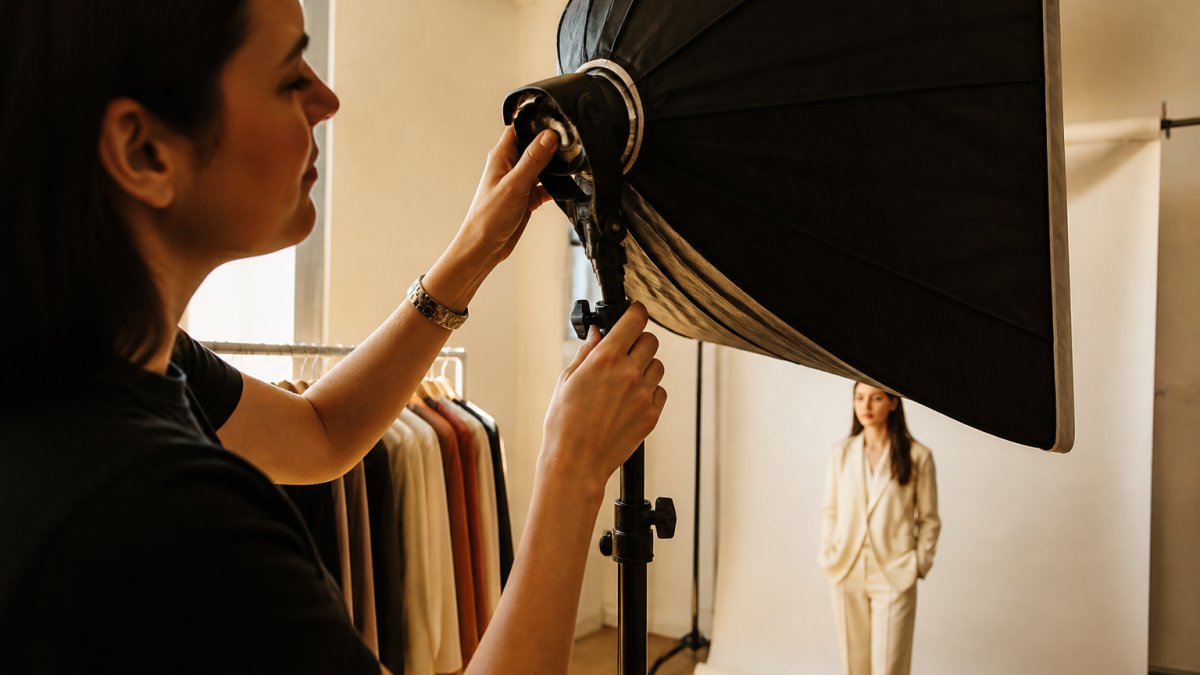
Most guides describe the look but skip the clock. Here is the timed sequence we use to keep a fast set moving, with a hard stop at each stage so the model is never waiting on a light change.
The Timed Build, Minute by Minute
- Minutes 0-2, Mark the floor and set the key stand. Tape an X where the model will stand and a second mark for the key stand at roughly 45 degrees, slightly above eye level. Having the marks down before the light goes up is what makes the rest of the build repeatable.
- Minutes 2-5, Aim and test the key. Point the center of the modifier at the face, not the body. Take one test frame. Check the shadow side: if it falls into pure darkness, you have rotated too far around the subject.
- Minutes 5-7, Add fill only if the shadow needs lifting. A white reflector on a stand is usually faster than a second head. If you use a strobe for fill, set it well below key power so the shadow stays visible.
- Minutes 7-9, Add a backlight only if the garment needs separation. A stripbox behind the subject is the usual choice. If the first two lights already read well against the background, skip this step entirely.
The key light, or main light, sets the mood and the direction of every shadow on set. Get it wrong and no amount of fill will rescue the frame. Get it right and the rest is refinement.
A common mistake is starting with two lights because it feels safer. It is not. Two lights built at once means two problems to solve at once, and on a fast set you rarely get the time to solve either.
When to Stop Adding Lights
Use this as a decision rule rather than a checklist. Add the next light only if the current frame fails a specific test:
- Shadow side too dark to read the garment? Add fill.
- Subject merging into the background? Add a backlight or rim.
- Background too bright or distracting? Flag or grid the backlight before adding anything new.
- Frame already reads well? Stop. Every additional fixture is another thing to aim, reset, and strike.
Set your key, fill, and backlight on separate stands with taped floor marks. When the model moves, you reset by feet, not by eye, and the setup survives the whole day.
What Slows a Build Down
The usual culprits are not gear failures. They are small process misses: hunting for a cable, re-aiming a light by eye after every pose, or discovering mid-look that the modifier is the wrong size. Keeping stands marked, cables coiled and labeled, and one spare modifier assembled covers most of it. The build is fast when nothing has to be figured out twice.
One-Light Fashion Photography: The Setup That Saves the Schedule
One-light fashion photography is a single key light, usually a softbox, shaped with a reflector and controlled by distance. It is the setup we reach for when the clock is tight or the room is small.
Why it works:
- Fewer decisions mean faster resets between looks
- One shadow reads as intentional, not accidental
- The look holds up across a full garment rack
- It fits in tight rooms and travels easily
Move the light closer for softness and falloff. Move it farther for a flatter, more even wash. Rotate it around the subject to change which side of the face carries the shadow.
Fashion Photography Lighting Equipment That Earns Its Place on Set
Fashion photography lighting equipment should be chosen for speed of setup, not for the size of the kit bag.
| Modifier | Best For | Speed of Setup | Trade-off |
|---|---|---|---|
| Softbox | Soft, even key light | Fast | Needs space to angle |
| Stripbox | Rim and backlight on garments | Fast | Narrow spread |
| Umbrella | Quick, broad fill | Fastest | Less control of spill |
| Beauty dish | Clamshell and beauty looks | Medium | Harder falloff |
| Reflector | Lifting shadows | Fastest | Needs a stand or assistant |
A softbox is the workhorse. A stripbox separates a shoulder or a sleeve from the background.
For studio work, a studio strobe gives consistent power and fast recycling. For location work, a battery-powered LED light or a compact strobe travels lighter.
Packing every modifier “just in case” slows the whole set. Each extra stand is another thing to trip over, aim, and strike. Bring the two or three you will actually use and leave the rest in the case.
Exposure Starting Points and Troubleshooting Mid-Shoot
Exposure on a fast set needs a fixed starting point you can return to after every change. Pick one aperture, one shutter speed, and one ISO, and adjust light power rather than camera settings. Changing the camera between looks is what creates a lookbook that reads as ten separate shoots instead of one collection.
A practical starting workflow:
- Set a mid-range aperture for consistent depth across the garment.
- Set shutter speed within your camera’s flash sync range.
- Keep ISO low and fixed.
- Adjust strobe power to hit your target brightness.
- Tether to a laptop or tablet and check each look before moving on.
Starting Settings to Adapt, Not Copy
Exact numbers depend on your camera, your modifiers, and the room, so treat these as a starting frame rather than a recipe:
- Aperture: a mid-range setting keeps the whole garment sharp while still separating the subject from the background. Open up only when you deliberately want the background to fall away.
- Shutter speed: stay inside your camera’s flash sync range so the strobe fires cleanly across the frame.
- ISO: keep it low and fixed. Raising ISO to fix brightness hides the real problem, which is usually light power or distance.
- Light power: make this your only brightness variable. One dial to turn means one thing to reset.
Write the settings down or photograph the back of the camera at the start of each look. That note is what lets you return to a known frame after a garment change, a model change, or a location move.
Tethering is the quiet hero of a fast set. Reviewing on a larger screen catches a blown highlight or a lost shadow before it costs you ten frames.
Common Mid-Shoot Problems and Fixes
- Harsh shadows under the eyes: raise the fill or add a reflector below the face. If the shadow persists, the key is too high or too close.
- Flat, lifeless light: move the key farther to the side and let shadow return. Flatness is usually a fill problem, not a key problem.
- Background too bright: flag the backlight or move the subject forward, away from the background.
- Inconsistent frames across looks: reset to your taped floor marks and your noted settings before changing anything else.
- Mixed color between lights: match the color temperature of every fixture on set, or gel the odd one out. Mixed color is far easier to prevent than to correct later.
The fastest fix on any set is returning to a known starting point. When something looks wrong, reset the camera and lights to your baseline before you start changing variables.
Keeping Exposure Consistent Across a Lookbook
Consistency is a lighting decision, not a retouching one. Keep the same key distance and power across the rack, change only what the garment requires, and shoot a reference frame at the top of each look. When the collection is reviewed later, the frames that match the reference are the ones that read as one story.
Lighting for Garments, Materials, and Skin Tones
Different garments and skin tones need different light, and the same setup will not flatter everything on the rack.
- Shiny fabrics: use a larger, softer source and angle it to control the highlight. Hard light on satin creates hot spots that clip.
- Matte fabrics: a slightly harder key brings out texture and weave.
- Dark garments: add a rim or backlight to separate the fabric from the background.
- Light garments: watch for blowout and pull the key back or lower power.
Skin tones deserve the same care. Soft, diffused light with a reflector for fill keeps highlights gentle and shadows open across a range of complexions.
What most guides miss is that consistency across a lookbook matters as much as any single frame.
Small Crews, Tight Rooms, and Location Changes
Small crews and tight rooms reward a light plan built for movement, not for a permanent studio. When you cannot fit three stands, you build one light and shape it well.
For a tight room:
- Use one key light and a reflector instead of two heads
- Put the light close to the subject and let falloff darken the background
- Keep stands tight to the wall and tape every cable
For location changes, a repeatable pack-down and setup order saves the most time:
- Strike in reverse order: backlight, fill, key.
- Coil and label each cable.
- Keep modifiers assembled where possible.
- Mark your floor positions at each new location.
We plan every editorial shoot around this rhythm. You can see how that discipline shapes our editorial portraits and the work in our published features.
The same fast-set thinking carries into portrait work, where natural window light and a single reflector often do the job. We bring that approach to family portraits and to women’s portraits as well.
Frequently Asked Questions
How do you light a fashion photoshoot quickly?
Start with one key light and build outward only if the schedule allows. Place the key light close to the model, roughly 45 degrees off the camera axis and slightly above eye level, then check exposure on the brightest garment in the frame. Adding a reflector for fill takes seconds and often removes the need for a second light. Lock the key light position, mark the floor, and change looks around it rather than rebuilding the lighting for every shot.
What is the simplest lighting setup for fashion photography?
One light, one modifier, and a reflector. A softbox or umbrella as the key light gives soft, even illumination that flatters most garments, and a white reflector opposite the key opens up the shadow side. This one-light-fashion-photography approach keeps the floor clear, speeds up teardown, and stays consistent across multiple looks. Many editorial sets use exactly this and add a backlight only when separation from the background matters.
Should you use flash or continuous lighting for a fast fashion set?
Flash usually wins on a fast set. Studio strobes output enough light to freeze movement and let you shoot at smaller apertures, and they run cool under hot lights and long days. Continuous LED lighting is easier to preview and works well for video capture or very tight spaces, but output drops quickly once you diffuse it. If the day includes both stills and motion, continuous light can reduce changeovers; otherwise strobes keep the pace.
How do you keep lighting consistent across multiple looks?
Fix the light positions and move the model instead. Tape marks on the floor for the model’s stance, keep the key light locked, and shoot tethered so you can compare frames side by side as looks change. When a garment needs different treatment, adjust power or swap a modifier rather than relocating stands. Consistent camera position and light direction across a set make the final edit feel deliberate rather than assembled from separate shoots.
A fast set is not about rushing. It is about deciding the light once, building it in order, and trusting the plan when the clock is tight. If you want a photographer who can hold a schedule and still capture the feeling behind a collection, KRISTIE Montrois brings editorial discipline, subtle direction, and a calm set to every shoot. Get started with KRISTIE Montrois and see your collection lit the way it deserves.

Be the first to comment