
How to Get Natural Family Photos Without Forced Posing
Table of Contents
- Why Forced Posing Makes Family Photos Feel Stiff
- How to Prepare for a Family Photo Session
- Natural Family Photo Prompts That Actually Work
- Family Photo Poses That Look Natural
- Family Photography Tips for Kids
- A Session Plan From Arrival to Final Photo
- Helping Camera-Shy Family Members Relax
- How to Keep Candid Moments and Still Get a Usable Group Portrait
- Frequently Asked Questions
Last Updated: October 7, 2026
Why Forced Posing Makes Family Photos Feel Stiff
The fastest way to ruin a family portrait is to ask everyone to stand still and smile. Natural family photos happen when people forget the camera is there, and that rarely happens on command.
Watch what happens when a photographer says “everyone look here and smile.” Shoulders rise. Jaws tighten. Kids start squirming.
Real expressions arrive in the gaps: a joke between siblings, a toddler breaking free to run, a dad catching a daughter mid-spin.
At KRISTIE Montrois, we swap instructions for gentle direction: set up a scene, give people something to do, and photograph what happens next.
Stiff photos are a timing problem, not a smile problem. Stop chasing the pose and start chasing the moment between poses.
How to Prepare for a Family Photo Session
Preparation removes most of the friction that makes people tense up. A little planning does more for natural expressions than any prompt we can give on the day.
What to Wear for Natural-Looking Photos
Choose clothes that feel like your family, not costumes. Coordinating colors works better than matching outfits, and comfort matters more than perfection.
- Pick two or three colors and let each person wear a variation
- Skip loud logos and busy patterns that pull focus from faces
- Choose fabrics that move well for walking, sitting, and picking up kids
The goal is a group that looks related without looking identical. If a child hates a stiff collar, that discomfort will show in every frame.
What Families Can Do the Day Before
Small steps the day before pay off in calmer, happier subjects.
- Lay out every outfit and check for wrinkles, missing buttons, and mismatched socks
- Feed kids a real meal beforehand, not a sugar rush
- Protect nap schedules so nobody arrives exhausted
One common mistake is treating picture day like a performance review. Kids pick up on that pressure and shut down. Frame it as a walk in the park with a friend who happens to have a camera.
Bring a small snack that doesn’t stain. A hungry toddler will not give you a single usable frame, and a chocolate-covered one will give you plenty of the wrong kind.
Natural Family Photo Prompts That Actually Work
Prompts beat poses because they give people a job instead of a position. Natural family photo prompts are simple instructions that spark real interaction, and the photographer captures what follows.
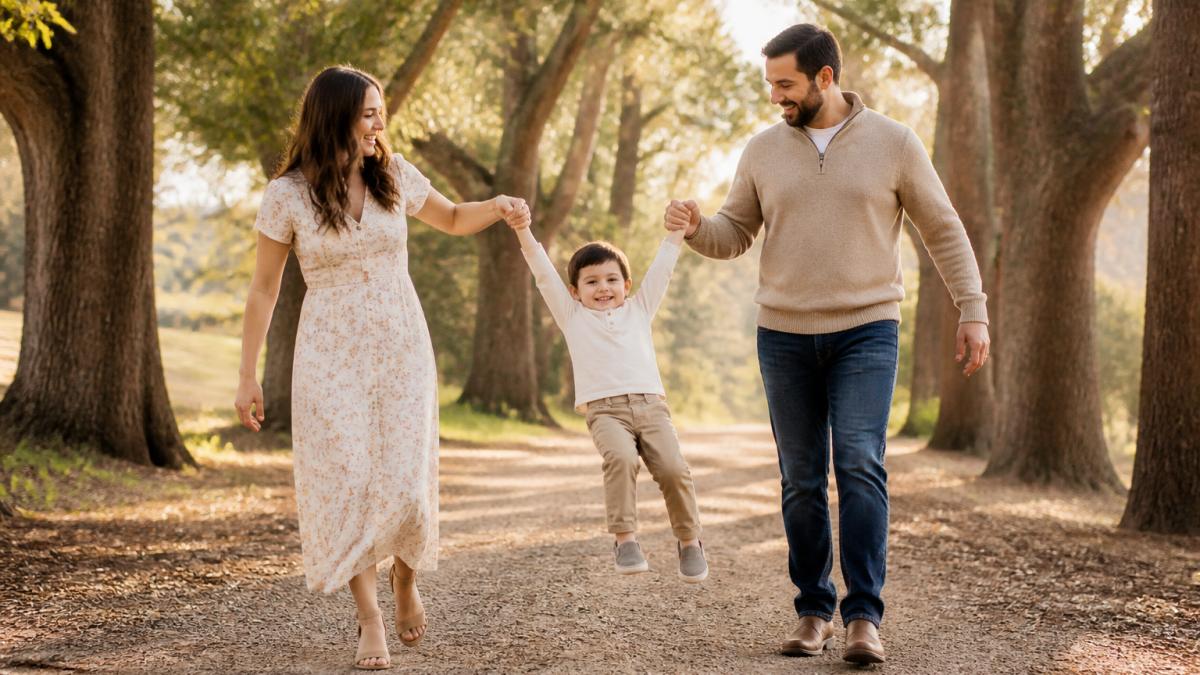
The best prompts are easy to understand, require movement, and produce a genuine reaction. A prompt library organized by age, energy level, and setting, with a backup ready, helps most during a session.
Prompts by Age and Energy Level
Different ages respond to different instructions. A prompt that delights a four-year-old will make a twelve-year-old roll their eyes, and one that works for a calm teenager will bore a toddler in seconds.
Toddlers and preschoolers (high energy, short attention):
- “Show me your best animal walk”, bear crawl, bunny hop, penguin waddle
- “Find three leaves and bring them to me”
- “Give the tallest person a running hug”
Early elementary (playful, competitive):
- “Whisper a secret to the person next to you”
- “Pick up your smallest family member and spin them once”
- “Tell me the worst joke you know”
Tweens and teens (low-key, dignity-preserving):
- “Look at each other, not at me, and remember your favorite trip”
- “Walk and talk about the last movie that made you laugh”
- “Stand back to back and see who’s taller now”
Adults and mixed groups:
- “Hold hands and take three big steps together”
- “Tell the person on your left one thing you appreciate about them”
- “Recreate a photo from ten years ago”
Notice none of these mention the camera. That’s the point. When people have something to do, their hands find natural places and their faces relax into real expressions.
Prompts by Setting
Where you’re shooting changes which prompts land. A park with room to run opens up movement prompts a small indoor space can’t support.
Outdoor, open space:
- Walking, racing, spinning, jumping
- Throwing leaves or blowing bubbles
- Climbing on a low wall or log
Outdoor, tight space (porch, garden, alley):
- Standing close and telling secrets
- Leaning against a railing together
- Passing a child from one adult to another
Indoor, home:
- Reading a book on the couch with a child on a lap
- Cooking or baking together at the counter
- Dancing in the kitchen
Prompt Examples With Alternatives
Some prompts land and some fall flat, so always have a backup ready.
| If this prompt falls flat | Try this instead | Why it works |
|---|---|---|
| “Smile at the camera” | “Tell me the worst joke you know” | Produces real laughter |
| “Stand still together” | “Walk and count your steps” | Adds movement, kills stiffness |
| “Look at me” | “Look at each other” | Creates genuine connection |
| “Give a nice hug” | “Sneak up and hug someone” | Surprise reads as authentic |
| “Say cheese” | “Whisper a secret” | Drops the performance, invites real reaction |
| “Hold still” | “Race to that tree” | Converts tension into motion |
| “Everybody look here” | “Look at the person who makes you laugh” | Redirects attention away from the lens |
| “One more smile” | “Show me your silly face” | Gives kids permission to be themselves |
If a family is stiff after two prompts, switch to a simple activity. Blowing bubbles, tossing leaves, or lifting a child in the air gives everyone something to react to, and reactions photograph better than instructions.
Adapting Prompts for Different Family Structures and Needs
Not every family fits the default script of two parents and young kids. Prompts should flex to the people in front of the camera.
- Blended and stepfamilies: Skip prompts that assume physical closeness. “Stand shoulder to shoulder” or “walk as a group” works better than “hug your sibling” when relationships are still forming.
- Single-parent families: Prompts that require two adults can leave one person stranded. Focus on parent-child interaction, or bring in a grandparent, aunt, or close friend for group frames.
- Multigenerational groups: Give grandparents seated or supported prompts (“tell the kids a story,” “hold hands with the youngest”) and let younger members move around them.
A prompt is a suggestion, not a command. If someone resists, drop it and try something else. The goal is a real moment, not compliance.
Keep a short list of prompts on your phone or in your back pocket. When a family freezes, reading from a list looks like a plan, not a panic.
Family Photo Poses That Look Natural
Natural family photo poses are less about position and more about relationship. They work because the body language already tells a story before anyone looks at the lens.
The trick is staggering heights and turning bodies. A group lined up at the same level looks like a team photo; a loose triangle with some standing, some sitting, and some leaning looks like a family.
- Staggered heights: place taller people behind or beside shorter ones so faces sit at different levels
- Turning bodies: angle shoulders slightly toward each other instead of squaring up to the camera
- Loose clusters: leave small gaps so the group doesn’t look like a solid wall
Hand Placement and Giving People Something to Do
Hands are the giveaway. When people don’t know what to do with them, they clasp, fidget, or hang awkwardly at their sides.
The fix is to give every hand a job. A hand on a shoulder, a child on a hip, fingers laced together, arms draped across a sibling’s back.
For a group portrait, build the arrangement from the inside out. Place the people who touch most often at the center, then add outward. Parents hold kids.
Family Photography Tips for Kids
Children don’t pose, and asking them to try is a losing game. Family photography tips for kids start with one rule: follow their energy instead of fighting it.
Let kids move. Run, jump, twirl, and explore. A child mid-laugh, caught in motion, makes a better photo than a child seated and smiling on demand. Keep sessions short and let breaks happen when they’re needed.
Matching the Approach to the Child’s Age
A toddler and a ten-year-old need completely different handling. What works for one will backfire with the other.
- Under two: Expect short windows. Work fast, keep the parent close, and photograph whatever the child is already doing. Snacks, a favorite toy, and a familiar blanket do more than any instruction.
- Two to four: Give them a job. “Hold this leaf,” “show me your shoes,” “find something red.” Movement prompts beat sitting prompts every time.
- Five to eight: Lean into games and silliness. Races, jokes, and challenges land well. They want to win, so give them something to win.
Working With Kids Who Need Extra Time
Some children warm up in seconds. Others need the whole session. Patience matters most with children who need extra time, including kids with sensory sensitivities, anxiety, or developmental differences.
A few approaches that help:
- Let the child lead the pace. If they need to explore first, let them. The camera can wait.
- Skip the countdown. “Ready, set, go” adds pressure. Just start photographing.
- Reduce sensory load. Fewer people talking at once, no flash, no sudden movements, and a quiet corner if they need one.
Keeping Kids Engaged Without Overwhelming Them
A session with young children is really a series of short bursts. Plan for that.
- Get down to their eye level instead of shooting from above
- Let them hold something meaningful, like a stuffed animal or a flower
- Play a game instead of giving an instruction
If a child is done, they’re done. Pushing past that point rarely produces a usable frame and often costs the rest of the session. A short break with a snack and a walk usually resets the mood faster than any prompt.
Don’t save the hardest shots for the end of the session. Kids have a limited window of cooperation, and it closes earlier than most parents expect.
A Session Plan From Arrival to Final Photo
A predictable flow keeps everyone calm and helps the session feel like a visit rather than a shoot. Here’s how we structure a family session.
- Arrival and warm-up (first 10 minutes): Greet everyone, let kids explore, and take a few casual photos while people settle in
- Group portrait first: Capture the full-family frame while energy is high and outfits are fresh
- Movement prompts: Move into walking, playing, and interaction shots to loosen everyone up
- Break for kids: Let children rest, snack, or run while we photograph smaller groupings
- Candid stretch: Follow the family through an activity and photograph what unfolds
- Closing frames: End with a relaxed, quiet moment as the light softens
The order matters. Getting the group shot early means we’re not chasing it at the end when everyone is tired. The rest of the session is free to be playful.
Don’t save the big group portrait for last. By then, kids are done, parents are watching the clock, and the one frame you need most becomes the hardest to get.
Helping Camera-Shy Family Members Relax
Camera shyness is normal, and it usually fades once the camera stops feeling like a spotlight. The fix is to lower the stakes and give people time.
Start with the shyest person first, but don’t point the lens at them. Photograph them doing something else while they talk to someone nearby. Once they forget you’re there, the real expressions show up.
A few things that help:
- Skip the countdown and the “ready, set, go” pressure
- Let people look away from the camera, at each other, or into the distance
- Talk about something they love instead of directing their face
For adults worried about how they’ll appear, gentle direction goes a long way. If you’d rather be the one in front of the camera for a change, our Women’s portraits offer the same relaxed, guided approach in a session built around you.
How to Keep Candid Moments and Still Get a Usable Group Portrait
You don’t have to choose between a real moment and a frame that works on the wall.
Take the arranged group shot first, then keep shooting as people relax out of it.
Then build the group portrait out of real interaction.
That’s the balance we aim for in every session: enough structure to get the shot, enough freedom to keep it honest.
Family photos should preserve how your family actually feels, not just how it lines up. Our Family Portraits sessions focus on gentle guidance, natural light, and the in-between moments that carry the most meaning.
Frequently Asked Questions
How can you make family photos feel less posed?
Give everyone something to do instead of a position to hold. Walking, lifting a child, or whispering a joke creates real expressions that a camera can catch. Movement also fixes the small stiffness that creeps in when people stand still and wait. A relaxed session built around activity, not a lineup, produces natural family photos that still work as a group portrait.
What are some easy posing prompts for family photos that actually work?
Try prompts that involve touch or motion: walk toward the camera holding hands, lift the youngest child between two adults, or have everyone look at each other and laugh at a shared memory. Each prompt gives hands a job and creates genuine connection. If one prompt falls flat, switch to another immediately rather than repeating it. Two or three prompts that land beat ten that feel forced.
How do you help kids relax during a family photo session?
Let children move. Family photography tips for kids usually come down to lowering pressure: no threats about behaving, no promises of treats for smiles. Instead, play a quick game, ask them to show you something, or let them lead a walk. Kids who are allowed to be themselves settle faster, and the candid moments between poses often become the photos families love most.
How long should a family photo session last?
Most families do well with 30 to 60 minutes, and young children often peak in the first 20. A shorter session keeps energy up and reduces the meltdown risk that comes with a long day. If you are booking a mini session, expect a focused window with a handful of prompts and plenty of in-between moments rather than an extended shoot.

Be the first to comment