
Why Fall Family Photos Are Perfect for Holiday Cards
Table of Contents
- Why Fall Family Photos Make Holiday Cards Easier
- When to Take Family Photos for Christmas Cards
- Fall Family Photo Outfit Ideas That Hold Up in Print
- Holiday Card Photo Ideas: Choosing Images That Work on Paper
- Fall Family Portrait Tips for a Calm, Natural Session
- Weather, Rescheduling, and Backup Plans
- Conclusion
- Frequently Asked Questions
Last Updated: October 6, 2026
Why Fall Family Photos Make Holiday Cards Easier
Fall family photos solve a timing problem most households run into every December.
At KRISTIE Montrois, we photograph families the same way we approach editorial work: with patience, natural light, and a light hand. The goal is real connection, not stiff smiles.
Here is the simple math. Fall portraits happen in September and October. Holiday cards need to be ordered and mailed in November.
Fall family photos work for holiday cards because the season supplies the backdrop, the light, and the lead time. You are not creating a scene. You are using one that already exists.
The rest of this guide covers when to book, what to wear, which images print well, and how to handle weather. Below, we break down each step so nothing feels rushed.
When to Take Family Photos for Christmas Cards
The best time to take family photos for Christmas cards is early to mid-fall, ideally late September through October.
Think in reverse. Work backward from the date you want cards in mailboxes.
- Late September to mid-October: Book and shoot your session
- Mid to late October: Review your gallery and pick favorites
- Early November: Design and order cards
- Mid to late November: Address and mail
That timeline keeps you ahead of the December crunch. Many print labs slow down as the holidays approach, so earlier is calmer.
Booking early also matters for a different reason. Weekend slots in October fill first, and preferred dates go quickly.
Fall Family Photo Outfit Ideas That Hold Up in Print
The best fall family photo outfit ideas share one trait: they look good in a photograph, not just in a mirror. Busy prints, tiny patterns, and logos compete with faces. Soft, layered fabrics in warm tones let people stand out instead.
Coordinated, Not Matching
Matching outfits went out of style for a reason. When everyone wears the same shirt, the photo looks like a uniform.
Coordinated is different. Pick a shared color palette, then let each person wear it their own way.
- Choose two or three base colors
- Mix in one accent tone
- Let each family member pick a piece that fits them
The result looks intentional without looking staged.
Colors, Fabrics, and Patterns That Work
Autumn colors are the easy win. Rust, mustard, olive, cream, and deep navy all sit well against foliage.
Fabric matters too. Textured knits, denim, and soft cotton add depth that flat fabrics lack. Small patterns like a fine stripe or a subtle plaid can work if one person wears them and everyone else stays solid.
Avoid large logos and bright neon. They pull the eye away from faces and date the photo fast. If you are unsure, lay every outfit on a bed together before the session. If the pile looks calm, the photo will too.
Holiday Card Photo Ideas: Choosing Images That Work on Paper
The strongest holiday card photo ideas are the ones built for a small frame. A card is not a wall print. It is a few inches wide, so simple, clear images read best. But choosing the image is only half the job. The other half is making sure that image survives the trip from your gallery to a printed card in someone’s hand.
What to look for in the gallery
- Faces are large and clear. A wide shot of a whole field can lose expressions at card size.
- There is room to crop. Cards come in portrait, square, and landscape shapes.
- The background is not busy. Fall foliage is great until it swallows the subject.
- Eyes are in focus. At card size, a soft expression is forgivable. Soft eyes are not.
Match the image to the card shape
Think about orientation before you fall in love with a photo. A tall portrait shot fits a vertical card. A wide family shot suits a horizontal card. Square cards are the most forgiving and accept almost any crop. If you are undecided, square is the safest choice because it gives you the most flexibility at the design stage.
Build a small set, not one hero shot
One wide shot for the front, a candid for the inside, and a close-up for the back gives the card a story. A three-image set also gives you options if the front image crops awkwardly once you see it in the card template.
Resolution and print quality
This is where most card projects go wrong. A photo that looks sharp on a phone can look soft on paper if the file is too small. When you order prints or cards, the lab will usually tell you the minimum resolution it needs for the size you selected. As a rule, the larger the printed card, the more resolution the image needs.
Digital delivery and proofing
After your session, your edited images are delivered digitally so you can review them from home. Take the time to look at each candidate at full size on a larger screen, not just on a phone. Zoom in on faces. Check the crop. Then decide which images go on the card before you start designing.
Ordering and mailing deadlines
Print labs get busier as the holidays approach, and turnaround times stretch. A realistic sequence looks like this:
- Session: late September through October
- Gallery review and image selection: within a week or two of delivery
- Card design and order: early November
- Printing and shipping: allow a buffer, not the minimum
- Addressing and mailing: mid to late November
If you are ordering cards for a large list, add time for addressing. That step is the one people forget, and it is the one that pushes cards past the postmark they were aiming for.
Do not choose a photo just because it is the most flattering single shot. If it cannot be cropped to fit your card shape without cutting off heads, or if the file is too small for the card size you want, it will cause a headache at the design stage. Check the crop and the resolution before you commit.
The card-friendly image is the one that is sharp, simply composed, and flexible enough to crop. Pick two or three candidates instead of one, and confirm resolution before you order.
Fall Family Portrait Tips for a Calm, Natural Session
A calm session produces better photos than a perfectly planned one. Our approach leans on subtle direction rather than rigid posing, so families relax and real moments show up.
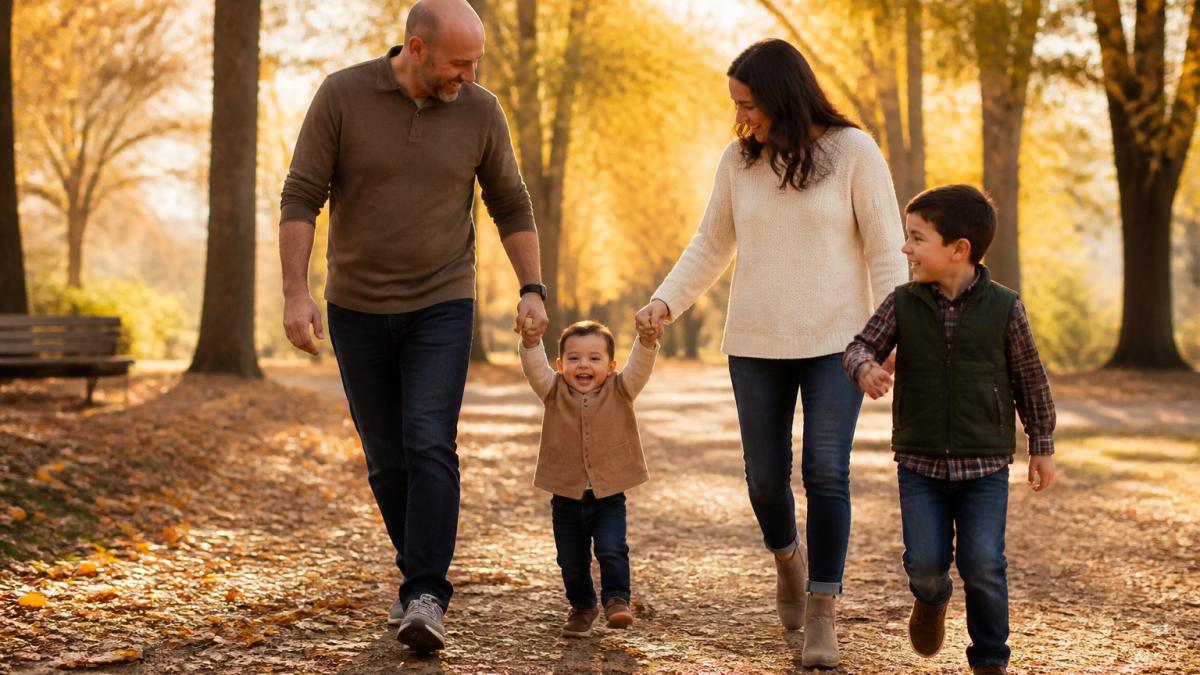
A few things help on the day:
- Move, do not pose. Walking, swinging hands, and gentle games create natural expressions.
- Let kids be kids. A toddler who will not sit still is not a problem. Movement is the point.
- Keep the mood light. Laughter and cuddles read better than a forced smile.
- Plan around naps and meals. A rested, fed child is a cooperative child.
For families with special needs children, patience is not a nice extra. It is the method. We follow the child’s pace, keep the environment predictable, and give plenty of breaks. The best frames often come from the in-between moments, not the posed ones.
Weather, Rescheduling, and Backup Plans
Fall weather is the one variable no one controls, so the goal is not to predict it. The goal is to decide in advance what you will do when it changes. A backup plan made at booking time costs nothing. A backup plan made the morning of a session usually costs you your card timeline.
Here is the framework we use.
Set the decision window
Check the forecast three days out, then again the evening before. Three days gives you time to move a session without scrambling. The evening before is when you confirm. Checking the radar every hour for a week only adds stress without changing the outcome.
Know your thresholds
Most photographers will shoot through light drizzle, overcast skies, and cool temperatures. The session usually moves for steady rain, high wind, or unsafe conditions. A few working thresholds help:
- Rain: Light mist is workable. Steady rain that soaks clothing is not.
- Wind: Gusts that move hair across faces constantly make editing harder and expressions tighter.
- Cold: When temperatures drop far enough that children are uncomfortable within minutes, the session stops being fun and starts being a countdown.
- Light: Heavy cloud cover flattens the warm golden-hour glow. It does not ruin a session, but it changes the look.
Build the backup before you need it
- Pre-book a rain date. Choose a second date when you book, ideally within the same week or two, so a storm does not push you into November.
- Have an indoor option. A covered porch, a bright living room with large windows, or a conservatory-style space can carry a session if the outdoors will not cooperate.
- Keep the wardrobe flexible. Layers work in both cool and mild conditions and add texture to the photo either way.
- Plan around golden hour, but do not depend on it. The hour after sunrise and before sunset gives the warmest light, and it is also the most fragile. Overcast days can actually be easier for even, flattering light.
If the session moves
Moving early is always easier than moving late. A session rescheduled with three days’ notice usually lands on a good date. A session rescheduled the morning of often lands wherever there is an opening, which may be after your card-ordering window has already started to close.
| Problem | Fix | Why It Matters |
|---|---|---|
| Rain on session day | Use your pre-booked rain date | Keeps you ahead of card deadlines |
| Harsh midday sun | Shift to golden hour or find open shade | Soft light flatters faces |
| Cold snap | Add layers and keep the session short | Warm families look relaxed |
| High wind | Move to a sheltered tree line or indoor space | Calm hair and clothing read cleaner |
| Busy fall calendar | Book early for preferred dates | Weekend slots fill first |
If you are booking a fall session specifically for holiday cards, ask about the rain-date policy before you book. Knowing the plan in advance turns a weather scare into a minor scheduling note instead of a missed deadline.
Conclusion
The hardest part of holiday cards is not the design. It is having a photo you love in time to use it.
At KRISTIE Montrois, we bring an editorial eye and a calm, patient approach to every session, whether that is family portraits or editorial work for global brands.
If you want updated portraits, holiday card images, and gifts for grandparents all from one session, now is the time to plan.
Frequently Asked Questions
What are the best colors to wear for fall family photos?
Build your palette around muted, earthy tones that echo the season: rust, mustard, olive, cream, camel, and soft charcoal. These read well against fall foliage and print cleanly on a holiday card. Pick two or three core colors and let each person wear a different combination of them. Avoid neon, large logos, and busy cartoon prints, which pull attention away from faces. If you are unsure, lay everyone’s outfits on a bed together and photograph them; if the group looks calm and cohesive, it will in the portrait too.
When should you take pictures for Christmas cards?
Aim to shoot in late September through October. That gives you time to receive edited images, choose card designs, order prints, and mail them before the December rush. Many card companies run promotions in November, and standard turnaround plus mailing can take two to three weeks. Booking a fall session early also means you have first pick of preferred dates and weekend slots, which fill quickly once the foliage turns. If you miss October, early November still works, but the timeline gets tighter.
How do you choose a photo for a holiday card?
Start with the card format. A flat 5×7 card usually suits a horizontal image, while a folded card often works better with a vertical one. Look for a frame where every face is visible, expressions feel genuine, and there is some open space around the family for text. If no single image has everyone looking at the camera, choose one where the connection feels strongest; a candid laugh often beats a stiff smile. Order a small test print before committing to a large run.
What should you avoid wearing for family photos?
Skip neon colors, large logos, graphic tees, and tight repeating patterns like small checks or thin stripes, which can shimmer in photos. Avoid everyone wearing the same solid color head to toe; it flattens the group and hides individual personality. Also think about footwear, since shoes often appear in full-length frames. Bring a backup top for anyone prone to spills, especially young children, and steer clear of anything you will be tugging at or adjusting all session.

Be the first to comment