
Planning a High-End Fashion Campaign: A 2026 Guide
Table of Contents
- Define Your Campaign Goals and Creative Direction
- Build Your Creative Team and Assemble Talent
- Develop Your Visual Language With Fashion Editorial Mood Board Examples
- Create a Fashion Campaign Production Timeline
- Execute Production and Manage the Shoot
- Use a Fashion Shoot Production Checklist for Flawless Execution
- Measure Campaign Performance and ROI
- Frequently Asked Questions
Last Updated: September 18, 2026
Define Your Campaign Goals and Creative Direction
Planning a high-end fashion campaign begins with clarity on what you’re trying to achieve. Before assembling your team or scheduling a single shot, you need to articulate your creative vision in concrete terms. This isn’t about vague aspirations, it’s about defining measurable objectives that guide every decision down the line.
Start by identifying your target audience with specificity. Are you speaking to luxury consumers aged 28-45 with six-figure incomes, or emerging professionals discovering the brand? The distinction shapes everything: the locations you scout, the styling choices, the mood board aesthetic. Your campaign goals should address both commercial outcomes (brand awareness, conversion, social engagement) and creative ones (establishing a visual language, communicating brand values, building editorial credibility).
According to McKinsey’s luxury consumer research, discerning clients increasingly seek authenticity and craftsmanship narratives in high-end marketing. This insight should inform your strategic planning. If your goal is to position the brand as timeless rather than trend-driven, your creative brief needs to reflect that from day one.
Document your vision in a creative brief that your entire team references throughout production. This brief should include: the campaign’s core message, the visual mood you’re targeting, the specific aesthetic elements (color palette, lighting style, composition preferences), and how the final images will be distributed. A clear creative direction prevents scope creep and keeps everyone aligned when decisions get difficult on set.
Define your campaign goals before you hire anyone. A photographer, stylist, and art director working from the same brief will make faster, better decisions than a team guessing at your intent.
Build Your Creative Team and Assemble Talent
Your team makes or breaks the execution. For a high-end fashion campaign, you need specialists who understand luxury storytelling and can collaborate under pressure. The core team typically includes a photographer, art director, stylist, makeup artist, and production manager, though smaller budgets might combine some roles.
Hiring a photographer is your most critical decision. Look for someone with proven editorial experience and a portfolio that matches your aesthetic. A photographer who excels at editorial photography understands how to balance creative vision with commercial needs. They know how to direct models with subtlety rather than rigid posing, how to work with natural and artificial light, and how to capture the feeling behind a moment, not just the surface.
The art director shapes the visual language across all assets. They work with the photographer to translate your creative brief into composition, framing, and styling decisions on set. A strong art director prevents the shoot from drifting into generic fashion imagery and ensures every frame reinforces your brand positioning.
Your stylist manages wardrobe, accessories, and overall aesthetic consistency. For high-end fashion campaigns, styling requires understanding proportion, fabric, color theory, and how garments photograph, skills that go beyond knowing what looks good in person. The stylist also sources or coordinates with designers if you’re featuring specific collections.
The makeup artist should have editorial experience, not just bridal or event work. Editorial makeup enhances the story and the photography style, it’s not about perfection, it’s about supporting the mood and the lighting.
A photographer who balances softness with subtle direction will capture authentic moments that feel effortless, even when every detail is carefully planned.
Develop Your Visual Language With Fashion Editorial Mood Board Examples
Your visual language is the aesthetic thread that ties all campaign assets together. It’s communicated through a mood board, a collection of reference images, color swatches, fabric samples, and inspirational photography that shows your team exactly what you’re aiming for.
A fashion editorial mood board should include 15-25 reference images that represent your target aesthetic. Pull from fashion editorials, fine art photography, film stills, and even architectural or natural imagery if it captures the mood you want. The goal isn’t to copy these references, it’s to establish a visual vocabulary your team understands without lengthy explanation.
Include specific fashion editorial examples that match your brand positioning. If you’re targeting the quiet luxury market, your mood board should feature understated elegance, natural fabrics, minimal styling, and soft, diffused lighting. If you’re going for bold editorial storytelling, include dynamic compositions, dramatic lighting, and strong color or pattern choices. The specificity matters.
Organize your mood board by category: color palette (include actual swatches or hex codes), lighting references (soft vs. dramatic, natural vs. studio), composition styles (close-ups, wide shots, environmental), styling direction (minimalist, layered, maximalist), and location/background aesthetics. This structure makes it easy for your photographer, stylist, and art director to reference during planning and on set.
Share your mood board digitally with the entire team at least two weeks before the shoot. This gives everyone time to absorb the direction, ask clarifying questions, and source elements (locations, wardrobe pieces, props) that align with the vision. A mood board prevents costly miscommunications and ensures your creative team is working from the same visual reference.
Create a Fashion Campaign Production Timeline
A realistic production timeline prevents last-minute scrambling and gives your team adequate time for planning. Most high-end fashion campaigns span 6-12 weeks from concept to final delivery, though this varies based on scope and complexity.
Break your timeline into phases.
Underestimating post-production timelines is a common mistake. Color grading, retouching, and asset optimization can take 20-30% longer than anticipated, especially for high-end fashion work where quality standards are exacting.
Execute Production and Manage the Shoot
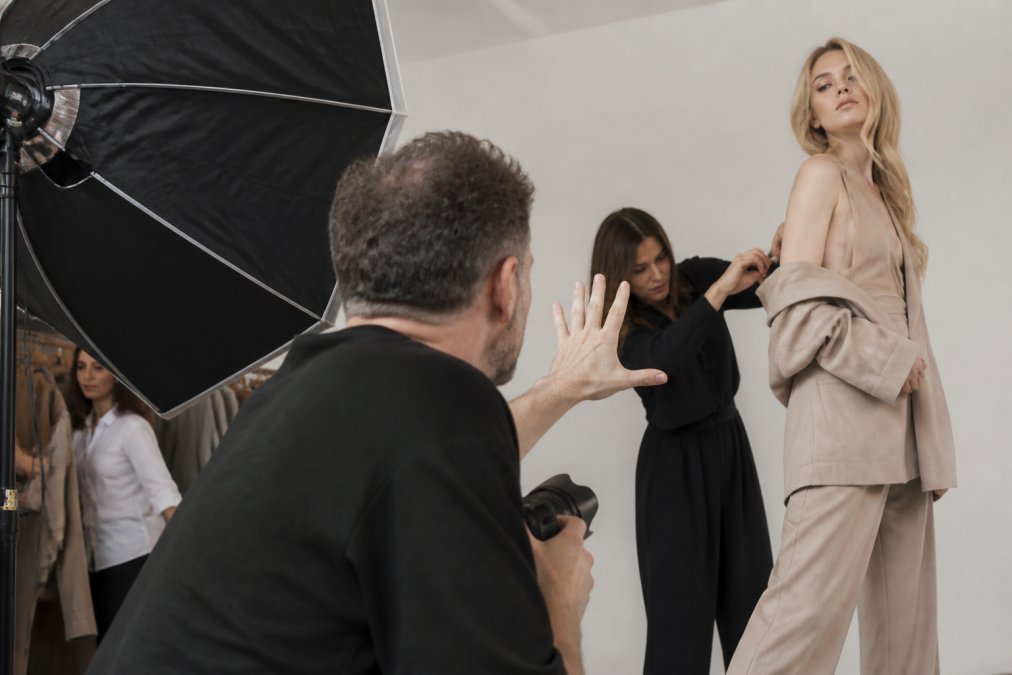
The shoot itself is where strategic planning meets real-world execution. A well-managed set keeps the team focused, maintains energy, and produces usable footage despite inevitable chaos, tight timelines, equipment failures, talent delays.
Use a Fashion Shoot Production Checklist for Flawless Execution
A comprehensive production checklist ensures nothing gets overlooked. This checklist becomes your team’s reference guide during the hectic pre-shoot and shoot days.
| Task Category | Specific Items | Timeline |
|---|---|---|
| Pre-Shoot Logistics | Location permits, equipment rentals confirmed, backup locations scouted | 2 weeks before |
| Talent & Styling | Model fittings completed, wardrobe steamed/pressed, accessories finalized | 1 week before |
| Crew & Equipment | All team members confirmed, equipment tested, backup gear on hand | 3 days before |
| Set Preparation | Lighting tested, backdrops set, props arranged, safety checked | Day before |
| Day-Of Coordination | Call times confirmed, catering arranged, shot list reviewed, backup plans discussed | Morning of shoot |
| Documentation | Behind-the-scenes photography, shot logging, contact sheets created | During shoot |
Measure Campaign Performance and ROI
After the shoot concludes and assets are delivered, measure what actually worked. This post-campaign performance analytics phase informs your next campaign and demonstrates the value of your investment.
Frequently Asked Questions
What are the essential phases of planning a high-end fashion campaign?
A high-end fashion campaign typically moves through five phases: strategic planning and goal-setting, creative team assembly and talent casting, visual development using mood boards and art direction, production execution with logistics and shoot management, and post-production with asset distribution and performance measurement. Each phase builds on the previous one, and alignment across all stakeholders at the start prevents costly revisions later.
How should I structure a fashion campaign production timeline?
Most luxury campaigns require 8-12 weeks from concept to launch. Allocate 2-3 weeks for planning and team assembly, 2-3 weeks for creative development and mood board refinement, 1-2 weeks for pre-production logistics and location scouting, 3-5 days for the actual shoot, 2-3 weeks for post-production and retouching, and 1-2 weeks for final approvals and distribution setup. Build in buffer time for revisions and unforeseen production challenges.
What should be included in a fashion shoot production checklist?
Your checklist should cover equipment and technical needs (cameras, lighting, backups), talent logistics (models, stylists, hair/makeup artists), wardrobe and styling materials, location permits and access, shot list and creative brief documentation, backup plans for weather or scheduling changes, and post-shoot asset organization protocols. A detailed checklist prevents overlooked details that could compromise image quality or delay delivery.
How do I measure the ROI of a high-end fashion campaign?
Track both quantitative and qualitative metrics. Quantitative measures include engagement rates across channels, website traffic and conversion data, sales attributed to the campaign period, and media impressions. Qualitative measures include brand sentiment shifts, customer feedback on campaign aesthetics, and positioning relative to competitors. Compare pre-campaign and post-campaign performance across all channels to establish clear ROI and inform future campaign budgets.
How do I choose the right photographer for my luxury fashion campaign?
Review portfolios for demonstrated expertise in editorial photography and luxury positioning. Look for photographers who understand your brand’s visual language and have experience managing fast-paced production environments. Request references from similar-scale clients, discuss their approach to art direction and collaboration, and assess their ability to capture both the technical requirements and the emotional energy of your collection.
What budget allocation makes sense for a high-end fashion campaign?
Budget allocation depends on your brand scale, campaign scope, and distribution strategy. Typically, allocate 30-40% to creative team and talent, 25-35% to production logistics and location, 15-25% to photography and post-production, and 10-20% to marketing and distribution. Luxury campaigns prioritize quality over volume, so invest in experienced professionals who understand your brand’s positioning and can deliver timeless, authentic imagery.
What makes a fashion editorial mood board effective for a high-end campaign?
An effective mood board combines visual references, color palettes, textures, and mood indicators that communicate your brand’s aesthetic and positioning. Include fashion editorials you admire, lifestyle imagery that reflects your target audience, color studies, and reference notes on lighting, styling, and overall energy. Share your mood board with all creative stakeholders early, photographer, stylist, art director, to ensure alignment before production begins.
How do I ensure the final campaign images match my creative director’s vision?
Establish clear communication before the shoot through detailed creative briefs, shared mood boards, and a comprehensive shot list. Schedule a pre-production meeting with your photographer and creative team to discuss art direction, lighting preferences, and styling details. During the shoot, review images in real time and provide feedback to allow for adjustments. A photographer experienced in luxury fashion understands how to balance creative direction with authentic storytelling to deliver images that feel both intentional and timeless.

Be the first to comment