
Natural Portrait Photography Session Tips
Table of Contents
- Why Natural Light Transforms Portrait Sessions
- Portrait Session Preparation Checklist for Clients and Photographers
- How to Direct Portrait Subjects Without Stiff Posing
- How Long Should a Portrait Session Last?
- Choosing the Right Time of Day and Ambient Conditions
- Camera Settings and Composition for Natural Results
- Handling Anxious or Neurodivergent Subjects With Care
- Post-Session Workflow for Natural Portraits
- Frequently Asked Questions
Last Updated: September 16, 2026
Why Natural Light Transforms Portrait Sessions
Natural light is the most forgiving tool in portrait photography, and it costs nothing. A window, an open doorway, or the shaded side of a building produces soft lighting that flatters skin tones and hides small imperfections harsh flash would amplify. This is why tips for natural portrait photography sessions almost always start with light, not gear.
The difference is physical.
Portrait Session Preparation Checklist for Clients and Photographers
Preparation is the difference between a relaxed session and a rushed one. A portrait session preparation checklist keeps both sides aligned before anyone steps in front of a lens.
What to Send Clients Before the Shoot
Send a short, friendly email three to five days ahead covering logistics, timing, and what to expect: location, parking notes, what to bring, and reassurance that no posing experience is required. Ask clients to flag anything that makes them anxious, from a recent injury to a child who needs time to warm up.
Grooming and Wardrobe Guidance That Prevents Distractions
Steer clients toward solid colors and textures that suit the setting; loud patterns, large logos, and busy prints pull attention from faces. Suggest two or three options to review on arrival. For grooming, advise neat but natural: tidy hair, fresh skin, minimal shine. The goal is to remove distractions, not make anyone look like a different person.
- Confirm location, time, and backup indoor option
- Send the preparation email with wardrobe guidance
- Ask about mobility needs, sensory sensitivities, or anxious subjects
- Charge batteries and format memory cards
- Scout the location for background clutter and soft lighting pockets
- Pack a reflector and a neutral backdrop cloth
Ask clients to arrive ten minutes early and leave their phone in the car. The first few minutes of unposed conversation do more for genuine smiles than any posing prompt you’ll use later.
How to Direct Portrait Subjects Without Stiff Posing
Stiff posing comes from over-instruction. The fix is subtle direction: give people something to do, not a shape to hold. But the deeper fix is psychological, lowering the perceived stakes of the frame so the subject stops performing and starts behaving like themselves.
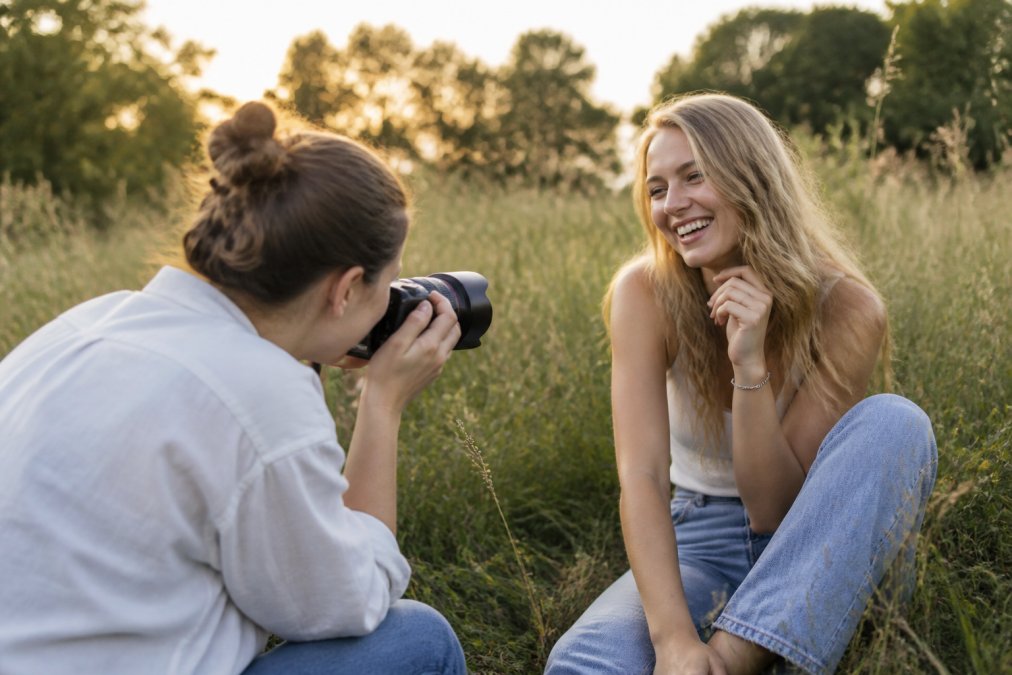
Lower the Stakes Before You Raise the Camera
The first frame is almost never the keeper, and saying so out loud helps. A useful script: “The first ten shots are just warm-ups, ignore them completely.” Experienced portraitists shoot continuously through the warm-up and never announce “this is the one,” because the moment a subject knows the real photo is happening, the shoulders rise and the jaw tightens.
Posing Prompts That Produce Genuine Smiles
Use prompts, not commands. Ask a client about the last thing that made them laugh, or to walk toward you while thinking about a favorite trip. Movement and memory both loosen body language. When someone relaxes mid-thought, that’s the frame.
A few prompts that reliably produce unforced expressions:
- “Walk toward me and tell me what you’d order at your favorite restaurant.”
- “Look at the person next to you like they just said something ridiculous.”
- “Take a breath in through your nose and let it out slowly, I’ll shoot on the exhale.”
- “Think about the last time you laughed so hard you couldn’t breathe.”
Reading Body Language and Adjusting in Real Time
Watch shoulders, hands, and jaw. Raised shoulders mean tension; fidgeting hands mean the subject needs something to hold. Adjust quietly, one change at a time, and check in with short questions rather than directions. Stacking three corrections at once resets the subject’s confidence to zero.
A Posing Script for Anxious Subjects
Anxiety changes the order of operations. With a nervous subject, start with a task that has nothing to do with the camera:
- Orientation (first 2-3 minutes). Walk the location together. Point out where the light falls. No camera in hand.
- Low-demand frames (next 5 minutes). Shoot from behind or from the side while the subject looks at something else. These frames are throwaways, but they teach the subject that the shutter sound is harmless.
- Guided movement (next 10 minutes). Introduce one simple action, walking, turning, adjusting a sleeve, and shoot through it without stopping.
- Directed frames (rest of session). Only now introduce specific posing, and only one adjustment at a time.
Direct the task, not the body. A subject who is busy doing something cannot simultaneously be busy worrying about how they look.
How Long Should a Portrait Session Last?
A natural portrait session typically runs 60 to 90 minutes for individuals and up to two hours for families or editorial work. Shorter sessions keep energy high; longer sessions risk fatigue and forced expressions.
Choosing the Right Time of Day and Ambient Conditions
Golden hour, shortly after sunrise or before sunset, delivers the most forgiving light of the day. The sun sits low, shadows soften, and skin glows without effort.
Camera Settings and Composition for Natural Results
Start with a wide aperture, around f/1.8 to f/2.8, for shallow depth of field that separates subject from background. Keep shutter speed at or above 1/250 to freeze small movements, and set white balance manually rather than trusting auto.
| Setting | Starting Point | Why It Works |
|---|---|---|
| Aperture | f/1.8 to f/2.8 | Shallow depth of field, soft background |
| Shutter speed | 1/250 or faster | Freezes natural movement |
| ISO | 100 to 400 | Keeps noise low in good light |
| White balance | Manual, set per scene | Consistent skin tones across frames |
| Focus mode | Single-point, eye priority | Reliable eye focus |
Trusting auto white balance across a session is the fastest way to get mismatched skin tones between frames. Set it manually once and leave it alone unless the light changes meaningfully.
Working Without Fast Glass or Pro Modifiers
Most natural-light guides assume an f/1.4 prime and a five-in-one reflector. You need neither. The physics of light does not care what the modifier cost.
- Kit lens instead of a prime. A kit zoom at f/3.5-f/5.6 still separates a subject from a background if you increase the distance between the subject and whatever is behind them. Subject-to-background distance does more for background blur than aperture alone. Move the subject three feet forward and the background falls away.
- White foam board as a reflector. A sheet of foam core from a craft store bounces fill light into shadowed eye sockets and under the chin. Hold it below chest height and angle it up; the effect is subtle and controllable.
- A white bedsheet as a diffuser. Taped over a window or held between the sun and the subject, a plain white sheet turns hard midday light into open shade. Keep the sheet out of the frame and watch for color casts, an off-white sheet will tint skin.
- A sheer curtain as a permanent softbox. A lightweight white curtain over a window is one of the most forgiving light sources available indoors. Position the subject two to three feet back from the curtain so the light wraps rather than flattens.
- A black jacket or dark towel as a negative fill. Placed on the shadow side of the face, dark fabric deepens shadows and adds dimension. Most photographers only think about adding light; subtracting it is often the faster fix.
Composition Adjustments for Tight Spaces
When you cannot back up, a small room, a crowded sidewalk, change the angle instead of the distance. Shoot slightly above eye level to compress the background, or from below to open up the sky behind the subject. A tilt of ten to fifteen degrees usually clears a distracting horizon line without making the frame feel crooked.
A Note on Gear Priorities
If you are buying one thing, buy a fast prime in the 50mm to 85mm range, the highest-return purchase for natural portraits. If you are buying nothing, the foam board and bedsheet will carry you further than most people expect. The settings above are starting points, not rules; the light in front of you always wins.
Handling Anxious or Neurodivergent Subjects With Care
Anxiety and sensory sensitivity change how a session should run, and most guides ignore this. The psychology of posing matters more than any technical setting when a subject is uncomfortable.
Post-Session Workflow for Natural Portraits
The work continues after the shoot, and a tight post-session workflow protects the natural feel of the images.
Frequently Asked Questions
How do you make portrait subjects feel comfortable during a session?
Start with conversation before you pick up the camera. Ask about their week, their kids, or what they’re excited about. When you do start shooting, give simple direction and praise specific things, like ‘that laugh was perfect.’ Keep the pace relaxed and let silence happen sometimes. Subjects who feel like they’re being talked to rather than posed will settle into natural body language within the first ten minutes.
What is the best way to direct a subject for natural-looking portraits?
Use prompts instead of poses. Instead of ‘put your hand here,’ try ‘walk toward me and tell me about your morning.’ Give one instruction at a time so the subject isn’t juggling three adjustments. Show them the back of your camera occasionally so they can see the results and trust the process. The goal is subtle direction that guides movement without freezing it into something stiff.
How does natural light impact the mood of a portrait session?
Light direction sets the emotional tone before you ever press the shutter. Soft, diffused light from an overcast sky or open shade produces even skin tones and a calm, intimate feel. Direct sunlight creates contrast and energy but can cause squinting. Golden hour light, roughly the hour after sunrise or before sunset, wraps subjects in warm tones that flatter nearly everyone. Match the light to the story you want the portrait to tell.
What are the most common mistakes in natural portrait photography sessions?
Shooting at high noon when the sun is directly overhead creates harsh shadows under the eyes and nose. Ignoring background clutter, like trash cans or parked cars, ruins otherwise strong frames. Rushing the first ten minutes before a subject relaxes leads to stiff expressions. Failing to check eye focus at a shallow depth of field is another frequent issue. Slow down, scan the frame edges, and give people time to settle in.

Be the first to comment